
A letter of demand is the formal step between chasing an unpaid invoice and starting legal action. Done well, it tells the debtor exactly what they owe, sets a firm deadline, and makes clear what happens next if they don't pay. Most importantly, it puts them on notice that you're serious — and that legal proceedings will follow if the debt isn't resolved. This guide covers what to include, when to send one, whether to use a lawyer, and provides a free template you can adapt.
What to include in a letter of demand
| Element | What to write |
|---|---|
| Heading | "Letter of Demand" — clear and prominent at the top |
| Your details | Full name, business name, ABN/ACN, address |
| Debtor's details | Full name and address (verify who owns the business — it may not be who you dealt with) |
| Date | The date the letter is sent |
| Amount owed | Exact dollar amount, including GST if applicable. Break it down if there are multiple invoices. |
| Basis for the debt | Brief description of the goods or services provided, referencing the contract or agreement |
| Invoice reference | Invoice number(s) and original due date(s) |
| Previous attempts | Mention earlier reminders sent (establishes your good faith) |
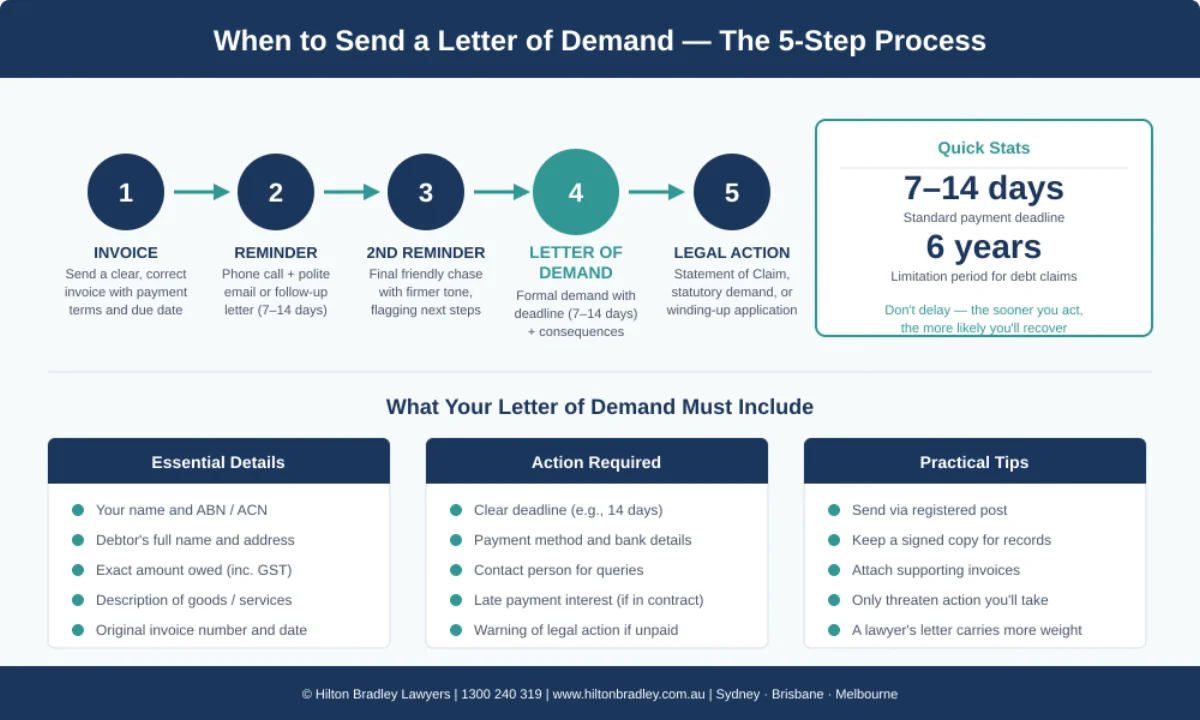
| Payment deadline | A specific date (typically 7–14 days from the date of the letter) |
| Consequences of non-payment | State that legal proceedings will be commenced without further notice, and that you will seek to recover legal costs from the debtor |
When to send a letter of demand
The right time to send a letter of demand is when your normal collection process has failed. If you've sent reminders, made phone calls, and the debtor still hasn't paid, a formal letter of demand is the next logical step. For most businesses, this is around 30–45 days after the invoice due date.
Don't wait too long. The longer a debt goes unpaid, the harder it is to recover. Debtors who are stalling may be using the time to move assets, wind down their business, or accumulate debts with other creditors. Sending a letter of demand early puts you ahead of other creditors and signals that you won't wait around.
DIY letter vs lawyer's letter
| DIY letter | Lawyer's letter | |
|---|---|---|
| Cost | Free | Typically $200–$600 fixed fee |
| Impact | Good for small debts between known parties | Significantly more weight; signals you're serious about legal action |
| Legal accuracy | Risk of errors that could weaken your position | Properly references legislation and contractual obligations |
| Follow-through | You need to manage next steps yourself | Lawyer can seamlessly escalate to court proceedings if needed |
| Cost recovery | May not recover costs from debtor | Legal costs can often be added to the debt if proceedings are commenced |
| Best for | Debts under $5,000; ongoing relationships | Debts over $5,000; unresponsive debtors; complex situations |

Letter of demand template (Australia)
Below is a practical template you can adapt. Replace the bracketed sections with your details.
LETTER OF DEMAND
[Date]
[Debtor's full name]
[Debtor's business name, if applicable]
[Debtor's address]
Dear [Debtor's name],
Re: Outstanding payment — $[amount] (including GST)
I refer to the [goods/services] provided by [your business name] (ABN [your ABN]) to [debtor's business name] under [the agreement/contract/purchase order] dated [date].
Invoice [number], dated [date], in the amount of $[amount] was due for payment on [due date]. Despite our previous reminders dated [dates of reminders], the amount remains outstanding.
I hereby demand payment of the full amount of $[amount] within [7/14] days of the date of this letter, being by [deadline date].
If payment is not received by that date, I will commence legal proceedings against you without further notice. I will seek to recover the debt together with interest pursuant to [applicable legislation or contract clause], filing fees, and legal costs. Those costs will be in addition to the amount currently outstanding.
Payment should be made by [method — e.g., direct deposit to BSB XXX-XXX, Account XXXXXXXX, Reference: Invoice [number]].
If you wish to discuss this matter or arrange payment, contact [your name] on [phone] or [email] immediately.
Yours faithfully,
[Your name]
[Your business name]
[ABN]
What happens after you send a letter of demand
If the debtor pays within the deadline, the matter is resolved. If they don't, you have several escalation options depending on who owes the debt:
- For company debtors ($4,000+): Issue a statutory demand under s 459E of the Corporations Act. This gives the company 21 days to pay or face a presumption of insolvency.
- For any debtor: File a statement of claim in the appropriate court. In NSW, the Local Court handles debts up to $100,000; the District Court handles debts up to $750,000.
- For judgment debts: Once you have a judgment, enforce it through garnishee orders, writs for levy of property, or examination notices.
The letter of demand also serves an important pre-litigation function. Courts expect parties to have made a genuine attempt to resolve disputes before commencing proceedings. A well-drafted letter of demand demonstrates that you gave the debtor a reasonable opportunity to pay before taking legal action.
Key takeaways
- A letter of demand is the formal bridge between chasing an unpaid invoice and starting legal action
- Send it around 30–45 days after the due date — don't wait too long
- Include the exact amount, invoice references, a firm deadline, and clear consequences for non-payment
- A lawyer's letter carries more weight and allows seamless escalation to court proceedings
- Courts expect you to have sent a demand before commencing proceedings
- If the debtor doesn't respond, escalate to a statutory demand (companies) or court proceedings
Need a letter of demand sent on law firm letterhead? Call Hilton Bradley on 1300 240 319 for a free consultation. We'll assess your debt, draft the letter, and follow through if the debtor doesn't pay.
Disclaimer: This article provides general information about letters of demand under Australian law as at February 2026. It is not a substitute for legal advice specific to your situation. For advice tailored to your circumstances, contact Hilton Bradley on 1300 240 319.
Disclaimer: The information in this article is general in nature and should not be relied upon as legal advice. Please seek professional advice tailored to your particular circumstances.

Luke Whiffen
Founding Director
Luke is a founding director of Hilton Bradley with over 20 years' experience in insolvency and commercial litigation.
View profile →