

A customer disputes your invoice. Now what? If you handle it badly, you could waste months chasing a dead end — or worse, have a statutory demand set aside with costs against you. The key is working out whether the dispute is genuine or tactical, then choosing the right response. This guide gives you a practical framework for assessing disputed invoices, responding effectively, and knowing when to escalate. It also explains why genuine disputes matter if you're considering a statutory demand under the Corporations Act.
What to do first when a customer disputes your invoice
Don't react emotionally, and don't ignore it. A disputed invoice needs a structured response, not a heated phone call. Here's what to do immediately:
- Ask for the dispute in writing. Request that the customer set out exactly what they're disputing and why. Vague complaints like "we're not happy with the work" aren't good enough — you need specifics.
- Review your records. Pull up the contract, purchase order, scope of work, delivery records, and any correspondence. Compare what was agreed with what was delivered.
- Separate the disputed amount from any undisputed portion. If the customer accepts $8,000 of a $10,000 invoice but disputes $2,000, pursue the undisputed amount immediately and deal with the $2,000 separately.
- Document everything from this point. Switch to email for all communication. If you have a phone call, follow up with a written summary. This trail becomes your evidence if things escalate.
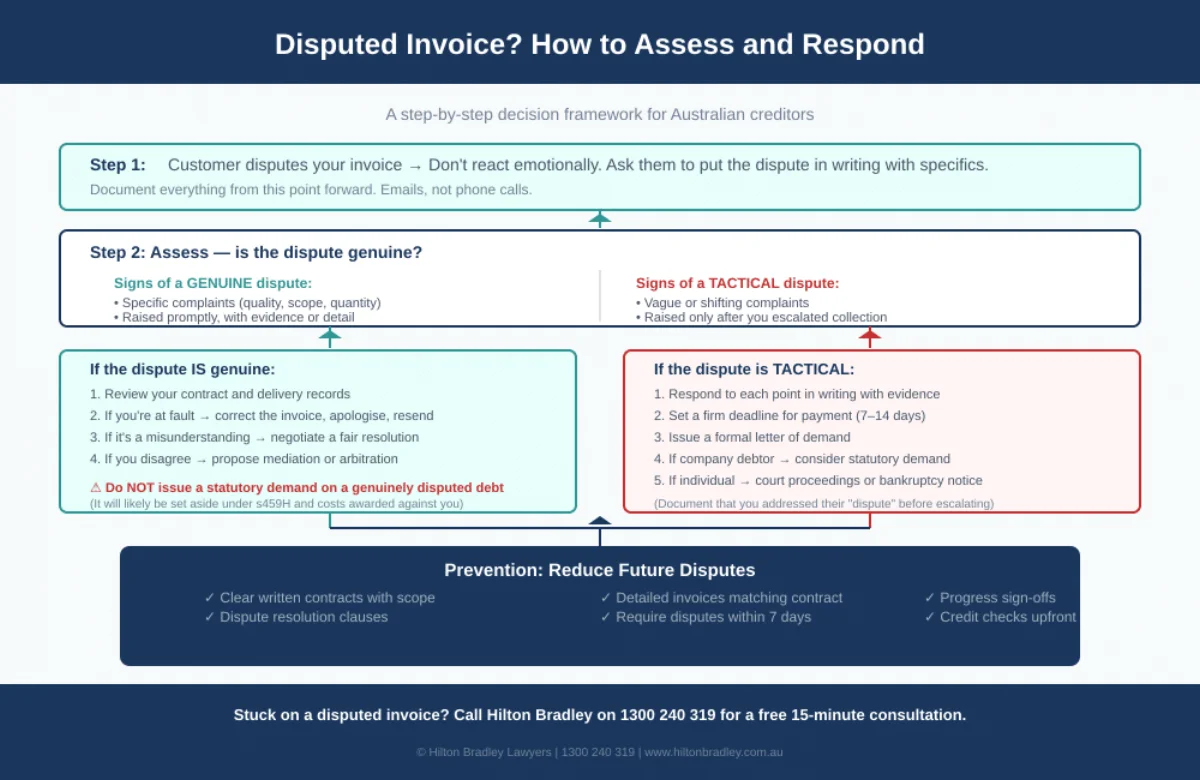
Genuine dispute or delay tactic? How to tell the difference
Not every dispute is genuine. Some customers manufacture complaints to buy time when cash is tight. The distinction matters because it determines your entire recovery strategy — and whether tools like statutory demands are available to you.
| Signs of a genuine dispute | Signs of a tactical dispute |
|---|---|
| Raised promptly after invoice received | Raised only after you chased payment |
| Specific complaints with detail | Vague or shifting objections |
| Relates to quality, scope, or terms | Relates to "cash flow issues" reframed as disputes |
| Customer provides supporting evidence | Customer avoids putting it in writing |
| Partial payment of undisputed amount | Refuses to pay anything at all |
| Customer engages constructively | Customer goes silent or stalls |
How to respond to a genuine dispute
If the dispute has substance, your goal is resolution — not escalation. A genuine dispute usually falls into one of three categories, and each needs a different approach.
You made an error
If you overcharged, invoiced for work not completed, or made a billing mistake, correct it promptly. Issue a credit note or revised invoice, apologise for the error, and request payment of the corrected amount within 7 days. Speed and professionalism here can actually strengthen the relationship.
There's a genuine disagreement
If both parties have a reasonable position — perhaps the scope was ambiguous, or there's a difference in expectations — negotiate a fair outcome. Consider offering a discount, a payment plan, or additional work to close the gap. Check your contract for a dispute resolution clause, and follow it. Courts expect you to have attempted resolution before commencing proceedings.
The customer is wrong but sincere
If the customer genuinely believes they have a point but the evidence is on your side, walk them through it. Send them the signed agreement, the delivery confirmation, or the relevant emails. A non-confrontational, evidence-based approach often resolves things without needing lawyers.

How to respond to a tactical dispute
If you're satisfied the dispute is manufactured — raised late, vague, or clearly designed to delay payment — you need to shut it down methodically and escalate.
- Respond to each point in writing. Address every complaint with evidence. This creates a record showing you took the dispute seriously, even if it wasn't genuine.
- Set a firm payment deadline. Give 7–14 days. Make clear that if payment isn't received, you'll escalate to formal recovery.
- Issue a formal letter of demand. A letter from a lawyer focuses minds. It also starts the clock on any pre-action requirements under your contract or court rules.
- Consider a statutory demand (for company debtors). If the debt exceeds $4,000, is due and payable, and you've addressed the "dispute" with evidence, a statutory demand under section 459E of the Corporations Act 2001 (Cth) may be appropriate. The company then has 21 days to pay, apply to set aside the demand, or face a presumption of insolvency.
The statutory demand trap: why genuine disputes matter
Here's where many creditors get it wrong. A statutory demand is a powerful tool, but it's not designed for disputed debts. Under section 459H(1)(a) of the Corporations Act, if there's a "genuine dispute" about the existence or amount of the debt, the court will set aside the demand.
The threshold for a "genuine dispute" is low. In Eyota Pty Ltd v Hanave Pty Ltd (1994), the court defined it as "a plausible contention requiring investigation". The debtor doesn't have to prove they'll win — just that the dispute is arguable, not fanciful.
If your statutory demand gets set aside, you'll likely pay the debtor's legal costs and lose months of time. That's why you need to resolve or eliminate the dispute before issuing a demand. Alternatively, obtain a judgment first — judgment debts are much harder to challenge by way of a genuine dispute defence.
How to prevent invoice disputes in the first place
The cheapest dispute to resolve is the one that never happens. These practical steps reduce your exposure:
- Use clear written contracts that specify scope, deliverables, milestones, and payment terms
- Include a dispute resolution clause requiring disputes to be raised within 7 days of invoice
- Get sign-off at milestones so the customer can't claim dissatisfaction after the work is complete
- Invoice promptly and accurately with clear line items matching the contract
- Run credit checks on new customers before extending trade credit
Key takeaways
- When a customer disputes an invoice, get the complaint in writing with specifics before responding
- Separate disputed amounts from undisputed amounts — pursue the undisputed portion immediately
- Assess whether the dispute is genuine (specific, timely, evidence-based) or tactical (vague, late, designed to delay)
- For genuine disputes, focus on resolution: correct errors, negotiate, or follow your dispute resolution clause
- For tactical disputes, respond with evidence, set deadlines, and escalate to a letter of demand
- Don't issue a statutory demand on a genuinely disputed debt — it'll likely be set aside under s459H with costs against you
- Prevent disputes with clear contracts, milestone sign-offs, and prompt, accurate invoicing
Stuck on a disputed invoice?
Call Hilton Bradley on 1300 240 319 for a free consultation. We'll help you work out whether to negotiate, demand, or litigate — and avoid costly dead ends.
Disclaimer: This article provides general information about responding to disputed invoices under Australian law as at March 2026. Your situation may involve specific factors that affect how the law applies to you. For advice tailored to your circumstances, contact Hilton Bradley on 1300 240 319.
Disclaimer: The information in this article is general in nature and should not be relied upon as legal advice. Please seek professional advice tailored to your particular circumstances.

Luke Whiffen
Founding Director
Luke is a founding director of Hilton Bradley with over 20 years' experience in insolvency and commercial litigation.
View profile →