

Winding up is the most serious step you can take against a corporate debtor. It ends the company and hands control to a liquidator. For a CFO or credit manager, the question that matters isn't how to do it, but when it's worth doing. This guide covers when applying to wind up a company in NSW makes commercial sense, when it doesn't, and what the process involves, including current thresholds and deadlines as at May 2026.
You've chased the invoice, sent the reminders, and maybe even a letter of demand. The company still hasn't paid. At some point you start wondering whether it's time to apply to wind the company up. It's a powerful move, but it isn't always the right one. The rest of this guide will help you weigh that up.
What winding up actually does
A winding-up order forces a company into liquidation. The court appoints a liquidator, the company stops trading, and its assets are gathered in, sold, and paid out to creditors in the order the law sets. It's governed by Part 5.4 of the Corporations Act 2001 (Cth), which applies right across Australia, NSW included.
That makes it fundamentally different from ordinary debt recovery. Suing for a judgment and then enforcing it, through a garnishee order or a writ for example, targets the money owed to you. Winding up targets the company itself. You're not just recovering a debt; you're ending the business.
| Ordinary debt recovery | Winding up | |
|---|---|---|
| What it targets | The debt the company owes you | The company itself |
| Typical outcome | A judgment you then enforce | Liquidation and a liquidator appointed |
| Who benefits | You alone | All creditors, shared by priority |
| Best when | The company can pay and keeps trading | The debt is clear and the company won't pay |
When applying to wind up makes sense
Winding up tends to be the right call when:
- The debt is clear-cut. It's due, payable, undisputed, and totals at least $4,000, which has been the statutory minimum since 1 July 2021.
- A statutory demand has been ignored. If the company doesn't respond within 21 days, it's presumed insolvent under section 459C(2). That's the cleanest path to a winding-up order.
- The company is trading but stalling. For a solvent business that simply won't pay, the threat alone often gets the cheque written. Directors don't want their company named in the public insolvency notices.
- Other enforcement has stalled. If you hold a judgment you can't enforce because the company has no seizable assets but is still operating, a liquidator can investigate where the money went.
A practical example. A Sydney supplier is owed $38,000 by a builder who keeps promising payment that never lands. A statutory demand goes unanswered for 21 days, giving the supplier a presumption of insolvency and a strong basis to apply. In practice, the builder pays in full days before the hearing rather than risk liquidation.
When you should think twice
Winding up isn't always the smart move. Step back if:
- The debt is genuinely disputed. You can't use a statutory demand, or a winding-up application, as a lever to collect a debt the company honestly contests. The company can apply to set the demand aside under section 459G, and pushing ahead can be treated as an abuse of process, with costs against you. Use a letter of demand and ordinary recovery instead.
- The company has no assets. Winding up is a hollow victory if there's nothing for the liquidator to realise. You could spend thousands and recover little.
- You want to be paid first. Liquidation is a collective process. Once a liquidator is appointed, recoveries are shared among all creditors by statutory priority, so bringing the application doesn't move you to the front of the queue.
- You'd rather keep the customer. If the relationship is worth saving and the business is viable, a payment plan may serve you better than ending it.

The pathway from unpaid debt to a winding-up order
Where the debt is undisputed and over the threshold, the usual route runs through a statutory demand:
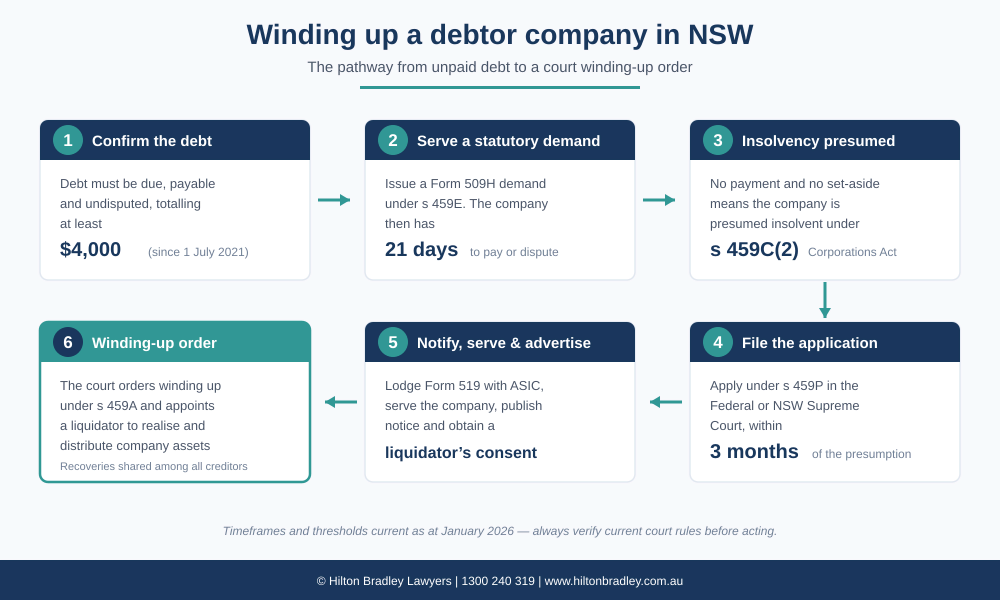
- Confirm the debt. It must be due and payable, undisputed, and at least $4,000.
- Serve a statutory demand. Issue a Form 509H demand under section 459E. The company then has 21 days to pay, reach a compromise, or apply to set it aside.
- Insolvency is presumed. If the company does nothing within 21 days, it's presumed insolvent under section 459C(2).
- File the application. Apply to wind the company up under section 459P in the Federal Court of Australia or the Supreme Court of NSW. You must do this within three months of the presumption arising.
- Notify, serve and advertise. Lodge a Form 519 with ASIC by 10:30am the next business day, serve the company at its registered office, publish notice on ASIC's published notices website, and obtain a registered liquidator's written consent to act (Form 8).
- Attend the hearing. If the application is unopposed and the presumption stands, the court makes a winding-up order under section 459A and appoints the liquidator.
You don't always have to start with a statutory demand. A creditor with a court judgment can rely on other evidence of insolvency, and the court can also wind a company up on other grounds under section 461, including where it's just and equitable to do so. But for most unpaid commercial debts, the statutory demand route is the most direct.
What you'll need before you file
Getting the paperwork right matters. Winding-up applications are struck out on technicalities far more often than they're lost on the merits. Before filing, you (or your lawyer) will need:
- A fresh ASIC company extract, obtained no more than seven days before filing, to confirm the registered office and check no one else has already applied.
- A liquidator's written consent to act (Form 8) from a registered liquidator.
- An Originating Process (Corporations Form 2) with supporting affidavits proving the debt, service of the demand, and non-compliance.
- Proof of notice, meaning evidence that you've notified ASIC and published the required notice, ready to file before the hearing.
How long it takes and what it costs
From filing to hearing is commonly six to ten weeks, depending on the court's list. The court generally must decide the application within six months or it lapses. Costs include court filing fees, the liquidator's consent (often with an upfront amount toward their costs), and legal fees. Those fees are frequently recoverable from the company if the order is made, though actual recovery depends on what assets exist. In many cases the debt is paid before the hearing once the debtor sees you're serious.
Key takeaways
- Winding up ends the company and appoints a liquidator. It's a last resort, not a routine collection step.
- It suits clear, undisputed debts of $4,000 or more where the company has ignored a statutory demand.
- Failing to comply with a statutory demand within 21 days creates a presumption of insolvency under section 459C(2).
- You must apply within three months of that presumption arising.
- Don't use it for genuinely disputed debts, because that risks an abuse-of-process finding and a costs order.
- Liquidation is collective: recoveries are shared, so applying first doesn't mean you're paid first.
Disclaimer: The information in this article is general in nature and should not be relied upon as legal advice. Please seek professional advice tailored to your particular circumstances.

Luke Whiffen
Founding Director
Luke is a founding director of Hilton Bradley with over 20 years' experience in insolvency and commercial litigation.
View profile →