

Most bad debts aren't caused by bad luck. They're caused by weak paperwork. Your terms of trade for credit are the cheapest debt-recovery tool you own, because they decide who pays, when, and what happens if they don't. This guide runs through the eight clauses that actually reduce bad debt, gives you sample wording for the ones that matter most, and finishes with a checklist you can run against your terms today. Get these right up front and you'll spend far less time chasing money later.
By the time an invoice is 90 days overdue, your options are mostly set by what your customer agreed to before you ever delivered. Tight terms of trade won't make every customer pay on time, but they decide how much leverage you have when one doesn't.
Why your terms of trade are your best protection against bad debt
Your terms of trade (often bundled with a credit application) are the contract that governs every sale on account. They set the payment date, the consequences of paying late, and the security you can fall back on if the customer goes under. When they're vague, or you never had the customer sign anything, you start every recovery on the back foot.
Strong terms set clear expectations so disputes are rarer. They give you faster remedies when payment slips. And they improve your position in an insolvency, where unsecured creditors usually recover little. The clauses below are where that strength comes from.

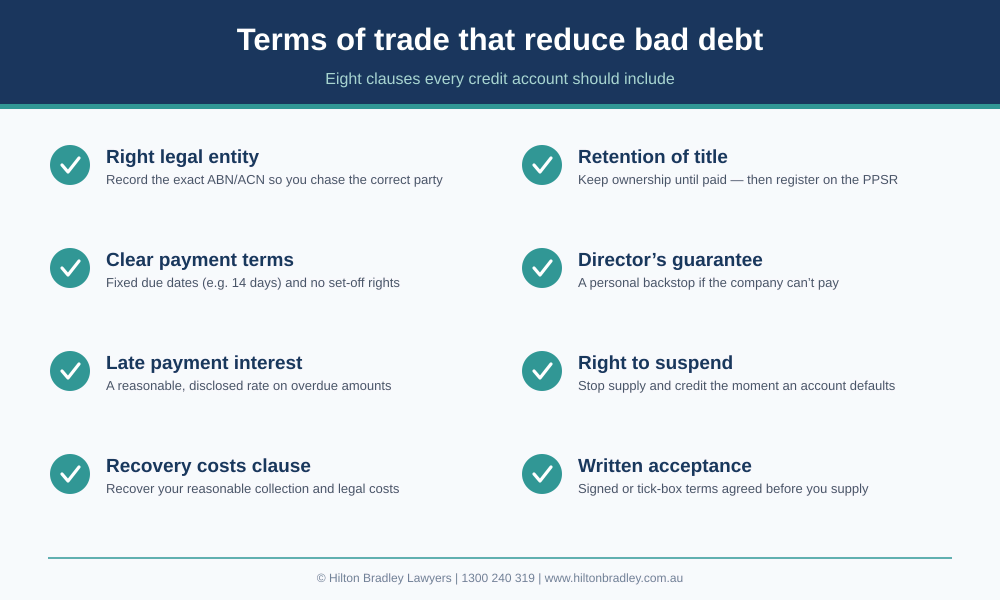
The eight clauses that do the heavy lifting
1. Identify the right legal entity
You can only enforce a debt against the party that actually owes it. Record the customer's exact legal name, ABN/ACN, and whether you're dealing with a company, sole trader, partnership or trustee. Getting this wrong is the single most common reason a recovery stalls, because you can't chase a trading name that doesn't legally exist.
2. Spell out payment terms (and rule out set-off)
State a fixed due date, since "within 14 days of invoice" beats "30 days EOM" for clarity, and say payment must be made in full without deduction or set-off. That stops a customer from short-paying because of an unrelated gripe and then arguing about it for months.
3. Late payment interest
A late payment interest clause compensates you for being out of pocket and nudges customers to pay on time. In Australia there's no automatic statutory right to interest between businesses, so you only get it if your terms say so. Keep the rate reasonable and clearly disclosed, because a punitive rate can be struck out as a penalty or an unfair term.
Sample clause. Interest is payable on any overdue amount at [insert reasonable]% per annum, calculated daily from the due date until the date payment is received in full, in addition to any other rights we have.
4. Recovery costs clause
By default, you generally can't recover the cost of chasing a debt, whether that's the time, the collection agency, or the legal fees. A recovery costs clause changes that, so the customer (not you) wears the cost of their own default. Tie it to reasonable costs that you actually incur; a blanket indemnity for "all costs whatsoever" is a classic unfair-term red flag.
Sample clause. If your account becomes overdue, you agree to pay all reasonable costs we incur in recovering the amount owing, including collection agency fees and legal costs on a full-indemnity basis to the extent permitted by law.
5. Retention of title, then register it
A retention of title (ROT) clause keeps you as the legal owner of the goods until you've been paid in full. It's powerful in an insolvency, but only if you perfect it. Under the Personal Property Securities Act 2009 (Cth), an ROT clause is a security interest that must be registered on the Personal Property Securities Register (PPSR) within strict timeframes. Miss the registration and your "retained" goods can vest in the customer's liquidator.
6. Personal or director's guarantee
When you supply a company, the company is the only thing on the hook, and a company with no assets is a dead end. A guarantee from a director or owner gives you a second party to pursue personally if the business can't pay. It's often the difference between a partial recovery and nothing.
7. Right to suspend supply and accelerate
Build in the right to stop supplying, put the account on hold, and call in the full balance the moment a payment is overdue. The threat of losing supply is one of the fastest ways to get a slow payer's attention, far quicker than a court.
8. Clear acceptance and a dispute process
Make sure the customer actually agrees to your terms, whether by a signature, a tick-box at checkout, or clear written acceptance before the first order. Then set a short window for raising genuine disputes in writing, and make clear that undisputed amounts are still payable on time. This stops a single contested line item from holding up the whole invoice.
Keep your terms strong, and keep them fair
There's a trap here. Standard-form terms of trade with consumers and small businesses are caught by the unfair contract terms regime under the Australian Consumer Law. Since November 2023, relying on an unfair term isn't just void; it can attract serious penalties. The ACCC and ASIC single out one-sided, disproportionate late fees and sweeping indemnities. So keep your terms balanced, transparent and proportionate to your genuine business interests. A clause that's too aggressive won't protect you, because it won't hold up.
Your terms of trade checklist
Run your current terms against this list. If you can't tick a row, that's where your bad-debt risk is hiding.
| Clause | Does your wording do this? |
|---|---|
| Right legal entity | Captures the customer's exact legal name, ABN/ACN and trading entity |
| Payment terms | States a fixed due date and rules out the customer withholding (set-off) |
| Late payment interest | Sets a reasonable, clearly disclosed rate on overdue amounts |
| Recovery costs | Lets you recover your reasonable collection and legal costs |
| Retention of title | Keeps ownership of goods until paid, and you register it on the PPSR |
| Personal guarantee | Gives you a director or owner to pursue if the company can't pay |
| Suspension / default | Lets you stop supply and credit the moment an account falls overdue |
| Acceptance & disputes | Records clear acceptance and a written process for genuine disputes |
If you've ticked every box but still aren't getting paid, the problem has moved from prevention to recovery. See our debt recovery service for NSW, use a letter of demand to put the customer on notice, or consider a statutory demand where the debtor is a company.
Key takeaways
- Terms of trade for credit are a prevention tool. They decide your leverage before a debt ever goes bad.
- Always capture the correct legal entity, a fixed due date, and a no set-off rule.
- A reasonable, disclosed late payment interest rate and a recovery costs clause shift the cost of default onto the customer.
- A retention of title clause is only as good as your PPSR registration, so register it on time.
- A director's guarantee and a right to suspend supply give you real-world recovery options.
- Keep every term fair and proportionate. Over-reaching terms breach the unfair contract terms rules and won't protect you.
Disclaimer: The information in this article is general in nature and should not be relied upon as legal advice. Please seek professional advice tailored to your particular circumstances.

Luke Whiffen
Founding Director
Luke is a founding director of Hilton Bradley with over 20 years' experience in insolvency and commercial litigation.
View profile →